
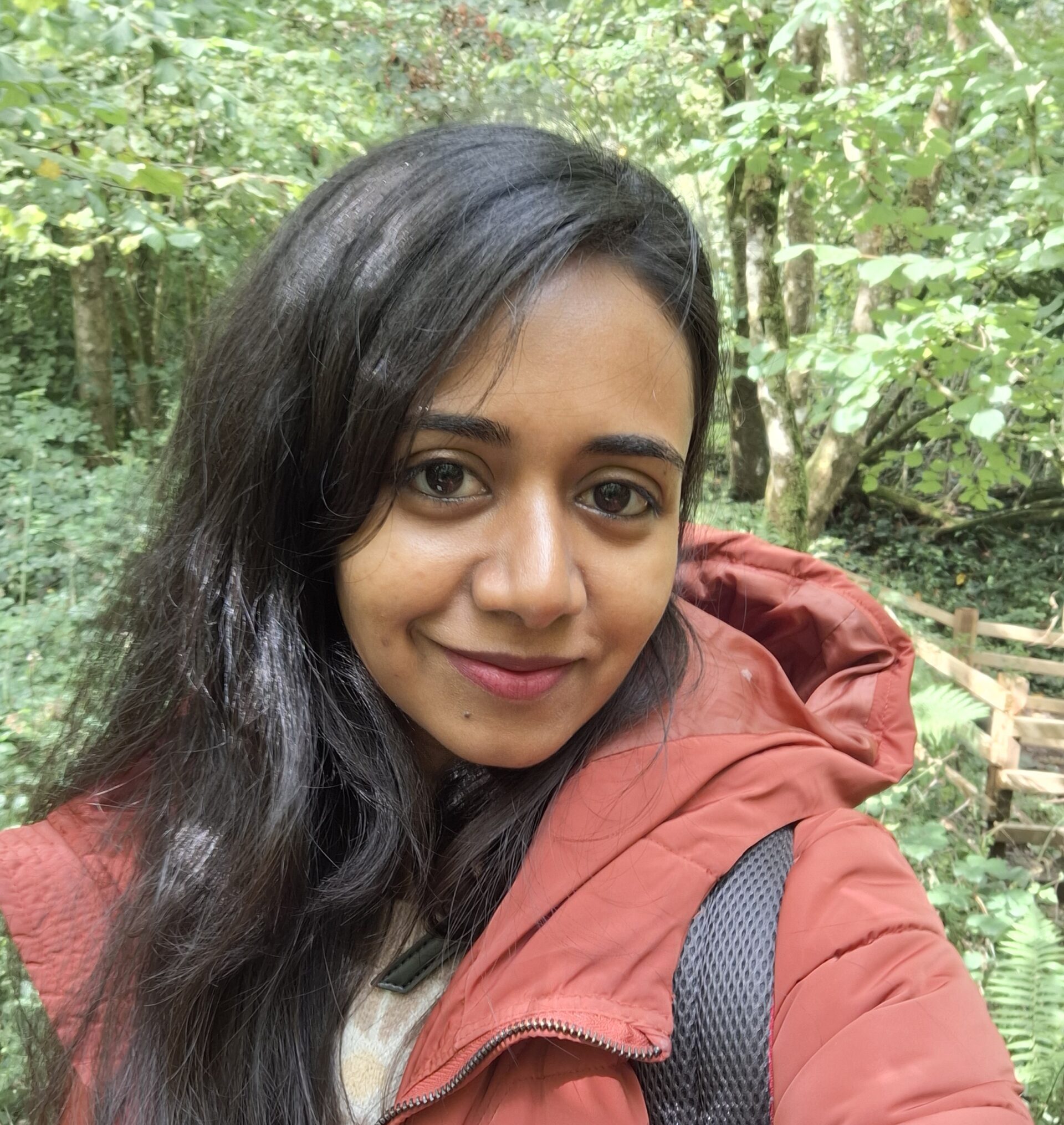
Rituparna Mondal is a third year Ph.D. candidate in the School of English at the University of Kent, Canterbury. She has completed her graduation and postgraduation degrees in Comparative Literature from Jadavpur University, India, where she was the second rank holder in both her Bachelor’s and Master’s degrees.
Her research interests include Dalit and Adivasi communities, everyday forms of resistance, vulnerable communities, alternative religious and ritualistic practices, Indigenous and Ethnic food cultures, and land rights. Her research focuses on investigating the fundamental material necessities of Dalit and Adivasi communities through an analysis of selected literary texts. She aims to utilise her research findings to create a quantitative-qualitative methodological tool that focuses on the domestic space to understand marginalisation.
Beyond research, she has professional experience in editing and proofreading. She has previously worked as an Assistant Editorial Intern at Wasafiri Magazine, QMUL. Currently, she serves as the lead editor of University of Kent’s postgraduate journal, Litterae Mentis.
Current Research:
My research focuses on analysing the representation of domestic space in twenty-first-century Dalit and Adivasi fiction. There has been a longstanding criticism that marginalised lives are either invisibilised or voiced by non-marginalised authors who fail (or refuse) to capture authentic marginalised experiences. I have, therefore, primarily focused on texts written in non-Hindi languages by authors who are either from marginalised backgrounds or are active allies of these communities. Some of the texts included in my research are: The Mysterious Ailment of Rupi Baskey, Sanatan, Dalit Lekhika, and Survival and Other Stories.
I draw on the theoretical frameworks of Postcolonial Literary Studies, Dalit Studies, Indigenous Studies, Political Economy, Cultural Theory, everyday practices, and Material Studies to investigate how the domestic spaces of communities residing in vulnerable locations are shaped by occurrences in the public domain. I argue that mainstream Hinduism, heavily influenced by the Brahminical religious paradigm, has created a nexus with neoliberal entities to constantly shape the ways in which Dalit and Adivasi communities negotiate their everyday lives.
At present, I am in India conducting ethnographic fieldwork in West Bengal and Jharkhand to observe Dalit and Adivasi issues concerning land, religion, food, and water. While micro-studies are essential for in-depth analysis, my research involves multi-sited ethnographic work, which is necessary to demonstrate how local experiences are inter-connected to wider, large scale socio-political and cultural concerns.
Areas of Study:
Dalits, Adivasis, Marginalised Literatures, Cultural Studies, Santhals
Publication: https://www.tandfonline.com/doi/full/10.1080/02690055.2025.2435181
LinkedIn: https://www.linkedin.com/in/ritu0203