

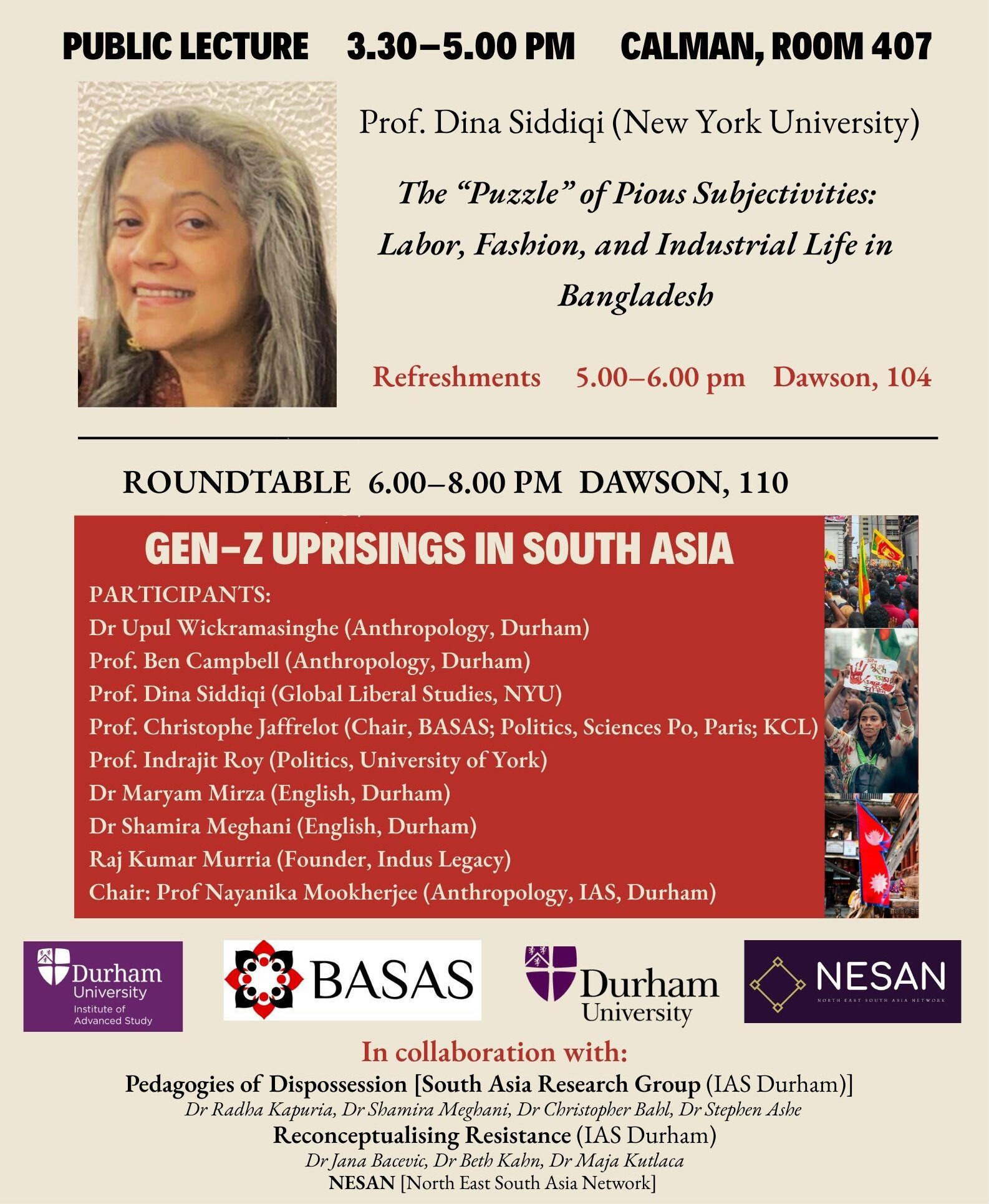
Event 1
SARG Lecture by Prof Dina Siddiqi (NYU): 3.30-5 pm, Calman CLC 407:
The ‘Puzzle’ of Pious Subjectivities: Labor, Fashion, and Industrial Life in Bangladesh
This paper puts the anthropology of labor in conversation with the anthropology of Islam, in the backdrop of critical development studies, to ask how we might reconceptualize gendered religious subjectivities if we looked through the lens of labor and the politics of class. My arguments build on but also move beyond the rich body of scholarship in the discipline on Muslim women. The questions are prompted by my experience as a long-time observer of labor in Bangladesh’s apparel export industry and recent ‘discrepant’ encounters with young working- class women as they navigate the competing discursive economies in which they are embedded. The analysis is anchored in an ethnographic fragment or ‘puzzle’ through which I think through the imbrications of labor and pious subjectivities. We inhabit a time when the ethical and political project of justice is no longer about making Islam legible or within the bounds of civilization as it was in the first two decades of the war of/on terror. Our current conjuncture, I contend, calls for de-exceptionalizing Islam in feminist ethnographic analyses.
Professor Dina M. Siddiqi is a cultural anthropologist and her research — grounded in the study of Bangladesh — joins critical development studies, transnational feminist theory, and the anthropology of labor and Islam. She has published extensively on the global garment industry and supply chains, non-state gender justice systems, and the cultural politics of Islam, feminism, and nationalism. She is currently engaged in a project on discourses of national development and the travels of civilizational feminism.
Refreshments: 5-6: D104
Event 2
Interdisciplinary Roundtable on Resistance and Genz Uprisings in South Asia
Dawson D110, 6-8pm
This roundtable wants to retrospectively map the forms, processes, effects and continuing ripples of the GenZ uprisings in Sri Lanka (2022), Bangladesh (2024) and Nepal (2025). GenZ refers to those born between 1997 and 2012 and their role in many of these uprisings are marked by digital dexterity and diversity. The reasons for these uprisings – these overt forms of resistance – have broadly been economic challenges relating to employment, access to resources of a liveable life. Alongside these protests have been against systemic corruption, nepotism, impunity and authoritarianism. While resistance is a much-debated theme in social science and humanities, we are also reminded of the pitfalls of romanticizing or overusing it. Between the bland appearance of consensus of ‘public scripts’ to the ‘hidden scripts’ of the powerless, lies the possibilities of tactics, strategy, irreconciliation and complicity to respond to power and its injustices. We also know how certain forms of resistance are celebrated and others are vilified at the same juncture. The role of geopolitics and conspiracy theories are closely intertwined with these uprisings and how does this affect the legitimacy of these movements? The semantic minefield is also a marker of their contested authenticity. For example, in Bangladesh whether one identifies the 2024 movement as an Obhuthan/Biplob (Uprising/Revolution), becomes a marker of different subject positions. The roundtable also juxtaposes protest movements in India and Pakistan, LGBT struggles in South Asia and Anti-Racism movements among diasporic communities in UK along with reflections from 2 IAS projects: Pedagogies of Dispossession and Reconceptualising Resistance
[Speakers include: Dr Upul Wickramasinghe (Anthropology, Durham); Prof Ben Campbell (Anthropology, Durham); Prof. Dina Siddiqi (Global Liberal Studies, NYU); Prof. Indrajit Roy (Political Science, York); Prof Christophe Jaffrelot (Chair, BASAS; Politics, Science Po, Paris; Kings College London); Dr Maryam Mirza (English, Durham); Dr Shamira Meghani (English, Durham); Raj Kumar Murria (Founder, Indus Legacy);Pedagogies of Dispossession – South Asia Research Group at Durham | IAS Durham and Reconceptualising Resistance | IAS Durham. Chaired by: Nayanika Mookherjee (Anthropology, IAS, Durham)]
For queries about any of these events please email Avarna Ojha avarna.ojha@durham.ac.uk